
Understanding the Sources of Activated Carbon: Coconut Shells, Coal & Wood
Release time:
2026-05-21
Author:
CarlCarbon
Source:
CarlCarbon
Abstract
There are various options for activated carbon available today, with some costing only a few dollars and some in the hundreds. What accounts for the differences? First of all, these three types of activated carbon are different materials. The gaps in pricing and strengths in performance can be traced back to differences in supply materials and differences in their pore structures. Let’s get into it!
Coconut Shell Activated Carbon: The High-Adsorption Powerhouse
Origins and Process
Food grade activated carbon are always made from the best, oldest, coconut shells from Southeast Asia. They go through carbonization at very high temperatures, followed by pure physical steam activation. The materials are naturally sourced and the processes are clean, as they leave behind no chemical residue. Coconut shell activated carbon boast very high safety ratings for mother-baby and food grade applications.
Pores and Strengths
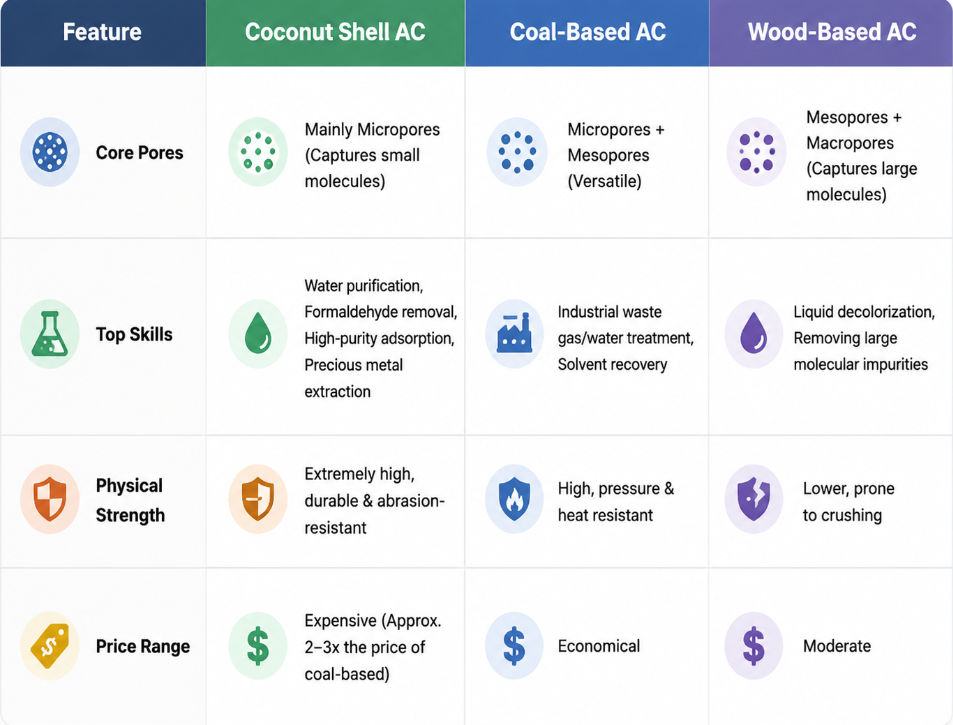
The biggest differentiator of coconut shell activated carbon is their micropore structure which can be less than 2 nanometers. This leads to high adsorption capabilities for residue chlorine in tap water, VOCs, odors, and formaldehyde. Hence, coconut shell activated carbon can be optimally used in drinking water purification systems and air filtration systems. They can also be used for food and beverage refining and even the extraction of precious metals.
Key Indicators
Coconut shell carbon usually has the highest specific surface area among the three, which can reach from 1000 to 1500 m²/g, sometimes even higher. Coconut shell carbon has a high Iodine Value, usually greater than all the other categories at 900-1100 mg/g, making it an even more attractive and valuable carbon source, since it offers greater adsorption capacity. On top of that, it is highly mechanically strong, abrasion resistant, and has a long service life.
Why is it expensive?
Due to the high cost and difficulty associated with importing the raw materials, as well as the use of a more expensive pure physical activation process, this is the most expensive activated carbon on the market.
Coal-Based Activated Carbon: The Industrial Heavyweight
Origins and Process
Coal-based activated carbon is derived from high-quality bituminous coal, anthracite, or lignite. After carbonization, the material is extruded and shaped into columns (or crushed into granules) and is then activated.
Pores and Strengths
Coal-based carbon has a balanced pore distribution that consists of both micropores and a majority of mesopores. Between these two classes of pore size distribution, this carbon can be used to adsorb not only small molecules but also larger size organic compounds. One of the biggest advantages of this carbon is its strength and hardness combined with elevated thermal resistance. Because of these properties, coal-based activated carbon is well-suited for the tough conditions of the industrial sector.
Key Indicators
Coal-based activated carbon usually has a low specific surface area (about 900-1000 m²/g) coupled with a comparatively higher ash content. Its overall performance is better than coconut shell carbon, but its adsorption performance cannot be compared with coconut shell carbon.
Why is it cheap?
Coal resources are cheap and the technology and processes to make this carbon have matured, so the cost is low. This carbon is used in large scale industrial wastewater treatment, water purification in power plants, flue gas desulfurization and denitrification, and solvent recovery.
Wood-Based Activated Carbon: The Decolorization Expert
Origins & Process
Produced using forestry by-products like wood chips, sawdust, and bamboo via chemical activation methods (such as phosphoric acid activation). This approach turns waste into valuable products, aligning perfectly with the principles of a circular economy.
Pores & Strengths
The most distinct feature of wood-based carbon is its abundance of mesopores and macropores (larger pore sizes). These spacious "channels" make it exceptionally good at adsorbing large-volume organic molecules. Consequently, it excels in liquid-phase treatment, particularly in decolorization and removing large molecular impurities.
Key Indicators
It typically has a very high Methylene Blue Value, an indicator specifically used to characterize mesopore volume and decolorization capability. However, wood-based carbon is relatively soft, has lower mechanical strength, and can easily wear down into powder.
Price Positioning
Prices generally fall between coal-based and coconut shell carbon. It is mainly applied in solution decolorization, purification, and deodorization for industries like sugar refining, MSG production, beverages, and pharmaceuticals.
At a Glance: Differences Between the Three Types
For a more intuitive comparison, you can refer to the table below:
Summary & Recommendations
If you are pursuing ultimate home water purification and respiratory health and have the budget, Coconut Shell Carbon is your top choice. For large factories treating sewage or exhaust gas where cost-effectiveness and durability matter most, Coal-Based Carbon is the go-to option. Meanwhile, if you need to decolorize sugar solutions or medicinal liquids, Wood-Based Carbon
Recommended Reading
2024-01-25
Activated Carbon for Monosodium Glutamate: MSG Decolorization and Refining Applications
2026-08-21
8 Hidden Reasons for Low Gold Recovery in CIP/CIL Plants — And How to Fix Them
2026-05-29
Spent Activated Carbon Regeneration: Methods, Benefits, and Limitations
2026-07-17
2026-09-16
Get a customized solution
Filling in your phone and email information will help us get in touch with you in a timely manner and resolve your issue as soon as possible.