
Activated Carbon for Gold Recovery: CIP, CIL Process, Carbon Selection and Regeneration Guide
Release time:
2026-09-30
Author:
CarlCarbon
Source:
CarlCarbon
Abstract
Activated Carbon for Gold Recovery: CIP, CIL Process, Carbon Selection and Regeneration Guide
 |  |
Gold extraction is one of the most important applications of activated carbon in the mining industry. In modern gold processing plants, activated carbon plays a critical role in recovering dissolved gold from cyanide leaching solutions and improving overall gold recovery efficiency.
With the development of large-scale mining operations, activated carbon for gold recovery has become a key consumable material in:
Carbon-in-Pulp (CIP) plants
Carbon-in-Leach (CIL) plants
Carbon-in-Column (CIC) systems
Gold adsorption and recovery circuits
The performance of activated carbon directly affects:
Gold adsorption capacity
Recovery efficiency
Carbon consumption
Operating cost
Overall profitability of gold processing plants
However, not all activated carbons provide the same performance.
Gold recovery applications require activated carbon with:
High adsorption capacity
Excellent mechanical strength
Low abrasion loss
Suitable particle size distribution
Stable performance during repeated processing cycles
Among different raw materials, coconut shell activated carbon is widely preferred for gold recovery because of its highly developed microporous structure, excellent hardness, and strong adsorption capability.
This guide explains how activated carbon works in gold recovery, its applications in CIP and CIL processes, how to select suitable carbon, and why production quality plays an important role in mining performance.
What Is Activated Carbon for Gold Recovery?
Activated carbon for gold recovery is a specially processed carbon material used to adsorb dissolved gold complexes from cyanide-based leaching solutions.
In conventional gold extraction processes, gold-containing ores are first treated through cyanidation, where gold reacts with cyanide to form soluble gold complexes.
The activated carbon then captures these dissolved gold complexes through adsorption.
The overall process involves:
Gold ore crushing and grinding;
Cyanide leaching to dissolve gold;
Contact between gold-bearing solution and activated carbon;
Adsorption of gold complexes onto carbon surfaces;
Gold recovery through desorption and refining.
Activated carbon is used because it provides:
Large internal surface area;
Developed pore structure;
Strong affinity for gold cyanide complexes;
Good chemical stability.
In industrial gold mining, activated carbon is not simply a filtration material. It acts as a highly efficient gold recovery medium that directly influences recovery performance.
Role of Activated Carbon in Gold Recovery
Activated carbon plays a central role in modern hydrometallurgical gold extraction.
Its main function is to selectively capture gold from leached solutions while allowing other components to remain in the process stream.
The effectiveness of activated carbon depends on several factors:
Carbon pore structure;
Surface chemistry;
Particle size;
Mechanical strength;
Contact time;
Gold concentration in solution.
High-quality gold recovery carbon helps mining operations achieve:
Higher gold recovery rates;
Lower carbon consumption;
Reduced gold losses;
More stable production performance.
How Activated Carbon Works in Gold Recovery
The gold recovery process using activated carbon mainly relies on adsorption.
After cyanide leaching, gold exists in solution mainly as gold cyanide complexes.
When activated carbon is added into the leached slurry, these complexes migrate to the carbon surface and enter the internal pore structure.
The adsorption process includes:
Gold Complex Diffusion
Gold-containing solution flows around activated carbon particles.
Gold cyanide complexes move from the liquid phase toward the carbon surface.
Surface Adsorption
The gold complexes attach to active adsorption sites on the carbon surface.
The high surface area of activated carbon provides numerous adsorption locations.
Pore Diffusion
Gold complexes enter the internal micropores of activated carbon.
The developed pore structure helps retain gold compounds and increases adsorption capacity.
Factors Affecting Gold Adsorption Performance
The adsorption efficiency of activated carbon depends on:
| Factor | Influence |
|---|---|
| Micropore Structure | Determines adsorption sites |
| Surface Area | Affects adsorption capacity |
| Mechanical Strength | Reduces carbon loss |
| Particle Size | Influences contact efficiency |
| Gold Concentration | Determines adsorption loading |
| Solution Conditions | Affects adsorption behavior |
A well-designed activated carbon product provides a balance between adsorption capacity and operational durability.
Activated Carbon Applications in CIP and CIL Gold Processing
Activated carbon is mainly used in two major gold recovery processes:
Carbon-in-Pulp (CIP)
Carbon-in-Leach (CIL)
Both technologies rely on activated carbon adsorption but differ in process arrangement.
Carbon-in-Pulp (CIP) Process
In the CIP process:
Gold ore is first leached with cyanide solution;
After gold dissolution, activated carbon is added;
Gold cyanide complexes are adsorbed onto carbon;
Loaded carbon is removed for gold recovery.
The CIP process separates:
Leaching stage
Adsorption stage
This allows better control of each step.
CIP is widely used in gold plants where:
Gold dissolution is relatively fast;
Leaching efficiency is already established;
High adsorption control is required.
Carbon-in-Leach (CIL) Process
In the CIL process:
Cyanide leaching and carbon adsorption occur simultaneously.
Activated carbon is added directly into the leaching tanks.
Advantages include:
Reduced process stages;
Shorter processing time;
Lower capital requirements for some projects.
CIL is commonly applied in modern gold processing plants due to its operational efficiency.
CIP vs CIL: Activated Carbon Requirements
Although CIP and CIL systems have different designs, both require activated carbon with:
High hardness;
Strong adsorption capacity;
Good resistance to abrasion.
Poor-quality carbon may cause:
Carbon breakage;
Fine carbon loss;
Gold loss with carbon particles;
Increased operating costs.
Therefore, selecting suitable gold recovery activated carbon is essential for both CIP and CIL operations.
Types of Activated Carbon Used for Gold Recovery
Different gold recovery operations require activated carbon with different performance characteristics.
In CIP, CIL, and CIC gold processing systems, activated carbon needs to provide a balance between:
High gold adsorption capacity
Excellent mechanical strength
Low abrasion loss
Stable particle size
Long service life
The selection of the right carbon type directly affects:
Gold recovery efficiency
Carbon consumption
Operating costs
Overall plant performance
The most commonly used activated carbons for gold recovery include:
Granular Activated Carbon (GAC)
Coconut Shell Activated Carbon
Coal-Based Activated Carbon
Wood-Based Activated Carbon
Among these materials, coconut shell activated carbon has become one of the preferred choices for gold recovery applications because of its unique pore structure and excellent mechanical properties.
Granular Activated Carbon for Gold Recovery
Granular Activated Carbon (GAC) is the most widely used activated carbon form in gold mining applications.
Compared with powdered activated carbon, granular activated carbon is better suited for:
CIP plants
CIL plants
Carbon adsorption columns
Continuous gold recovery systems
Its main advantages include:
Good Flow Performance
In gold recovery circuits, activated carbon must maintain effective contact with gold-bearing slurry.
Granular activated carbon provides:
Stable slurry circulation
Good solid-liquid contact
Suitable permeability
Efficient adsorption performance
The particle structure allows gold solutions to move through carbon layers effectively.
Lower Carbon Loss During Operation
During gold recovery, activated carbon experiences continuous mechanical stress from:
Agitation
Pump transfer
Screening
Regeneration cycles
Low-quality carbon may break down and generate excessive fines.
Carbon fines can result in:
Gold loss with carbon particles
Higher carbon consumption
Increased operating costs
Therefore, high-strength granular activated carbon is essential for long-term mining operations.
Suitable for Industrial Gold Processing
Granular activated carbon is widely applied in:
Large-scale gold mines
CIP gold plants
CIL gold plants
Precious metal recovery systems
Its combination of adsorption performance and durability makes it suitable for continuous industrial production.
Coconut Shell Activated Carbon for Gold Recovery
Coconut Shell Activated Carbon is one of the most important carbon materials used in gold recovery applications.
Because coconut shells naturally contain high carbon content, controlled activation can create a highly developed microporous structure.
This structure provides excellent adsorption sites for gold cyanide complexes.
Why Coconut Shell Activated Carbon Stands Out in Gold Recovery
Highly Developed Microporous Structure
Gold recovery depends on the ability of activated carbon to capture dissolved gold complexes from cyanide solutions.
Coconut shell activated carbon provides:
High micropore volume
Large adsorption surface
Efficient gold adsorption sites
The well-developed pore structure helps improve:
Gold loading capacity
Adsorption efficiency
Carbon utilization performance
Excellent Mechanical Strength
CIP and CIL processes expose activated carbon to demanding operating conditions.
Carbon particles must withstand:
Continuous mixing
Slurry transportation
Carbon screening
Multiple regeneration cycles
High mechanical strength helps reduce:
Carbon breakage
Fine carbon generation
Gold losses caused by carbon particles escaping the circuit
For mining operators, reducing carbon loss directly improves operating economics.
Stable Adsorption Performance
High-quality coconut shell activated carbon provides consistent:
Iodine value
Pore structure
Gold adsorption performance
Stable product performance is especially important for large-scale gold plants where continuous operation is required.
Key Properties to Consider When Selecting Gold Recovery Activated Carbon
Selecting activated carbon for gold recovery requires more than evaluating a single performance indicator.
A suitable product should provide a balance between:
Adsorption capacity
Mechanical durability
Chemical stability
Process compatibility
The most important quality parameters include:
Iodine Value
Iodine value is one of the key indicators used to evaluate activated carbon adsorption performance.
A higher iodine value generally indicates:
Better-developed micropores
More available adsorption sites
Stronger adsorption capacity for smaller molecules
For gold recovery applications, iodine value should be selected according to:
Ore characteristics
Gold concentration
Processing conditions
Mechanical Strength
Mechanical strength is a critical factor for gold recovery carbon.
In CIP and CIL plants, activated carbon may circulate through the system many times.
High mechanical strength helps:
Reduce abrasion loss
Minimize carbon fines
Extend carbon service life
For gold mining operations, carbon hardness directly affects:
Carbon consumption
Gold loss prevention
Total operating costs
Particle Size Distribution
Particle size affects:
Adsorption kinetics
Carbon screening efficiency
Slurry movement
Contact efficiency
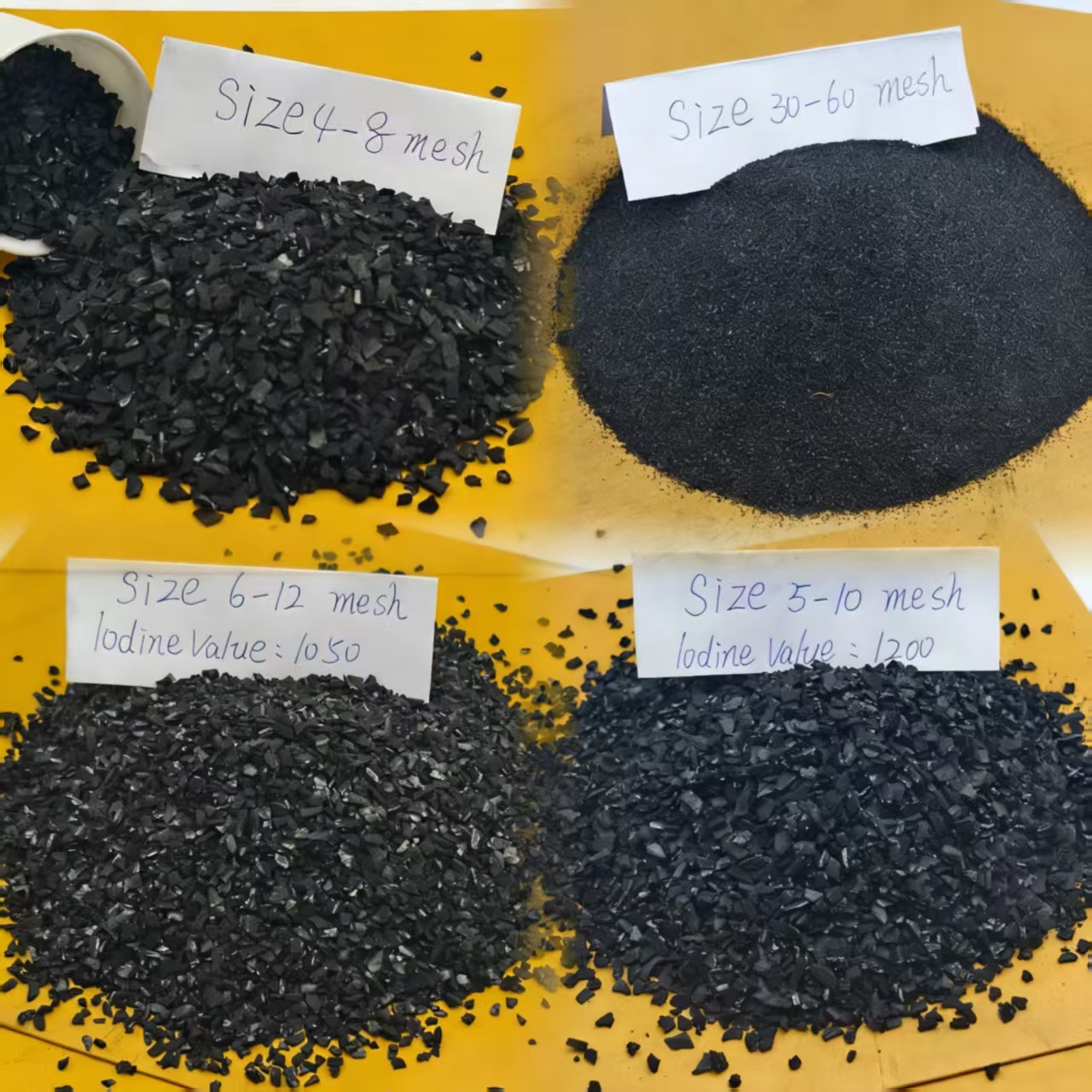
Common gold recovery carbon sizes include:
5×10 mesh
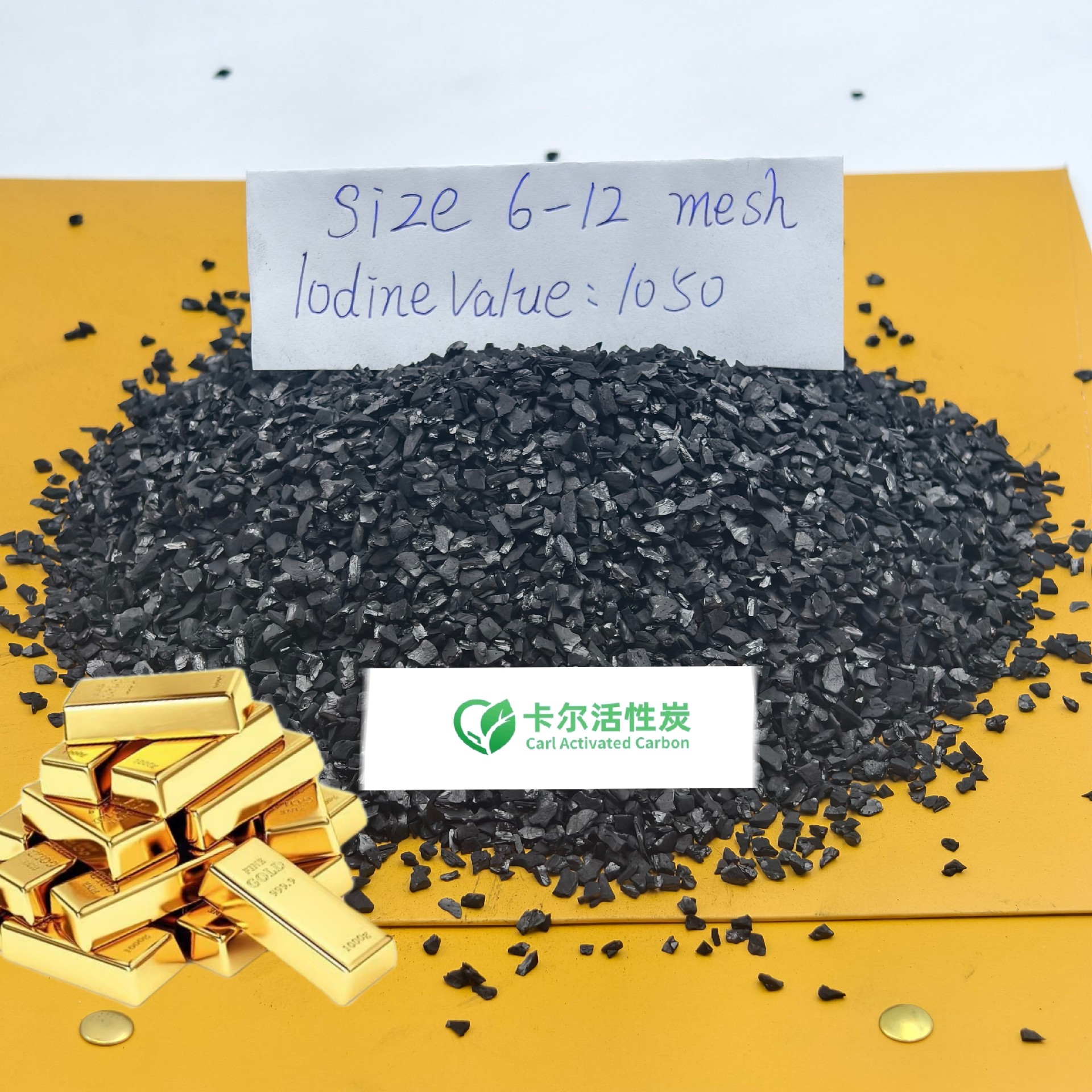
6×12 mesh
8×16 mesh
The correct particle size depends on:
CIP/CIL equipment design
Carbon screen specifications
Slurry characteristics
Moisture Content
Moisture content influences:
Effective carbon content
Transportation efficiency
Storage stability
Lower moisture activated carbon provides:
Higher active carbon percentage
Reduced transportation cost
Better economic efficiency
For exported gold recovery activated carbon, moisture control is an important part of quality management.
Ash Content
Ash content represents the amount of inorganic material remaining in activated carbon.
Lower ash content generally helps provide:
Higher carbon purity
More stable adsorption performance
Reduced interference from impurities
How High-Quality Activated Carbon Improves Gold Recovery Efficiency
The quality of activated carbon directly influences the performance of gold extraction systems.
High-performance gold recovery activated carbon helps mining operators achieve:
Reduced Carbon Consumption
Strong mechanical strength reduces:
Particle breakage
Carbon loss
Replacement frequency
This helps lower operational expenses.
Improved Gold Recovery Efficiency
Stable adsorption performance helps:
Capture more gold complexes
Reduce gold losses in tailings
Improve overall recovery efficiency
More Stable Production Performance
Consistent activated carbon quality reduces:
Process fluctuations
Adsorption variation
Frequent process adjustments
For large mining operations, product consistency is as important as adsorption capacity.
Manufacturing Quality Determines Activated Carbon Performance
The performance of gold recovery activated carbon depends not only on raw materials but also on manufacturing control.
Important production factors include:
Carbonization conditions
Activation temperature
Pore structure development
Screening accuracy
Quality inspection
Advanced manufacturing processes help produce activated carbon with:
More consistent pore structures
Stable adsorption performance
Reliable batch-to-batch quality
Why Coconut Shell Activated Carbon Is Preferred for Gold Recovery
Among different activated carbon raw materials, coconut shell activated carbon has become a widely used solution in gold recovery applications because it provides a strong balance between adsorption performance, mechanical durability, and operational stability.
For CIP and CIL gold processing plants, activated carbon must continuously perform under demanding conditions, including:
Long-term slurry contact
Repeated adsorption and regeneration cycles
Mechanical abrasion
Continuous carbon movement
Coconut shell activated carbon is especially suitable because of its natural carbon structure and controllable pore development during activation.
Advantages of Coconut Shell Activated Carbon in Gold Recovery
High Micropore Development for Gold Adsorption
The adsorption of gold cyanide complexes requires activated carbon with suitable pore characteristics.
Coconut shell activated carbon typically develops a high proportion of micropores, which provide:
Large adsorption surface area
Numerous active adsorption sites
Strong affinity for gold complexes
This makes it effective for recovering dissolved gold from cyanide leaching solutions.
High Mechanical Strength and Low Abrasion Loss
Mechanical strength is one of the most important factors for gold recovery carbon.
During CIP and CIL operations, carbon particles experience repeated:
Agitation
Pumping
Screening
Regeneration
Low-strength activated carbon may produce excessive carbon fines, resulting in:
Gold loss
Increased carbon consumption
Higher operating expenses
High-quality coconut shell activated carbon provides better resistance to abrasion and helps maintain stable operation.
Stable Performance During Multiple Cycles
Gold recovery carbon is often reused through multiple adsorption and regeneration cycles.
A reliable carbon product should maintain:
Adsorption capacity
Particle integrity
Stable physical properties
Stable carbon performance helps mining operators improve:
Carbon utilization efficiency
Production consistency
Long-term operating economics
Activated Carbon Manufacturing Process for Gold Recovery Applications
The performance of gold recovery activated carbon is closely related to the manufacturing process.
A controlled production system helps ensure:
Consistent pore structure
Stable adsorption capacity
Uniform particle size
Reliable mechanical strength
The main manufacturing stages include:
Raw material preparation
Carbonization
Activation
Screening and classification
Washing and purification
Quality inspection
Packaging and delivery
Raw Material Selection
High-quality activated carbon begins with suitable raw materials.
For coconut shell activated carbon production, manufacturers need to control:
Coconut shell source
Carbon content
Moisture level
Raw material consistency
Stable raw materials provide the foundation for consistent final product performance.
Carbonization Process
Carbonization converts coconut shells into carbonized material.
During this stage:
Volatile components are removed
Carbon structure develops
Initial pores are formed
Proper carbonization improves:
Structural stability
Activation efficiency
Final adsorption performance
Activation Process
Activation is the key stage that creates the adsorption structure of activated carbon.
Through controlled activation, manufacturers develop:
Micropores
Mesopores
Internal surface area
Activation parameters directly influence:
Gold adsorption capacity
Pore distribution
Product consistency
Important control factors include:
Temperature
Residence time
Steam flow
Heat distribution
How Production Equipment Upgrades Improve Gold Recovery Carbon Quality
For mining customers, activated carbon performance depends not only on product specifications but also on manufacturing stability.
Production equipment upgrades can improve:
Batch consistency
Carbon quality stability
Production efficiency
Supply reliability
Key improvements include:
Advanced activation systems
Automated temperature control
Improved screening equipment
Enhanced quality inspection systems
Advanced Activation Equipment for More Consistent Carbon Performance
Activation conditions determine the final pore structure of activated carbon.
Modern activation equipment enables more accurate control of:
Heating conditions
Activation time
Gas flow
Temperature distribution
This helps produce activated carbon with:
More uniform pore development
Stable adsorption performance
Reduced batch variation
For gold recovery applications, consistent carbon quality helps maintain predictable plant performance.
SLEP Furnace Technology for Coconut Shell Activated Carbon Production
For coconut shell activated carbon manufacturing, SLEP furnace technology provides improved process control compared with traditional rotary furnace production.
Traditional production methods may experience:
Uneven heat distribution
Different activation levels
Greater product variation
SLEP furnace technology uses controlled multi-zone heating to improve:
Carbonization consistency
Activation precision
Product uniformity
The process helps produce activated carbon with:
Stable adsorption properties
High mechanical strength
Consistent batch quality
These characteristics are particularly valuable for gold recovery applications where carbon performance directly affects operational efficiency.
Quality Control for Gold Recovery Activated Carbon
Reliable gold recovery carbon requires strict quality control throughout production.
Professional manufacturers should evaluate:
| Quality Parameter | Importance |
|---|---|
| Iodine Value | Indicates adsorption capacity |
| Mechanical Strength | Determines abrasion resistance |
| Moisture Content | Affects effective carbon content |
| Ash Content | Reflects product purity |
| Particle Size | Influences process compatibility |
| Surface Area | Represents adsorption potential |
A complete quality control system helps ensure every batch meets customer requirements.
Carbon Regeneration and Replacement in Gold Recovery
In gold mining operations, activated carbon is not always discarded after one use.
After adsorption, loaded carbon can go through regeneration processes to restore adsorption performance.
Carbon regeneration is an important part of reducing operating costs and improving carbon utilization.
What Happens During Carbon Regeneration?
Spent gold recovery carbon typically undergoes:
Acid washing or cleaning
Thermal regeneration
Cooling and screening
Reuse in adsorption circuits
During thermal regeneration:
Organic contaminants are removed
Carbon pore structure is restored
Adsorption capacity is recovered
Proper regeneration helps extend carbon service life.
How Many Cycles Can Gold Recovery Carbon Be Regenerated?
The number of regeneration cycles depends on:
Carbon quality
Gold plant operating conditions
Regeneration temperature
Chemical exposure
Mechanical wear
High-strength activated carbon generally performs better through repeated cycles because it maintains particle integrity.
Regeneration vs Replacement: When Should Carbon Be Replaced?
Regeneration is not always the best solution.
Replacement may be required when carbon experiences:
Excessive abrasion
Significant adsorption loss
Structural damage
High impurity accumulation
The decision should consider:
Carbon performance after regeneration
Cost of regeneration
Cost of new activated carbon
Plant recovery requirements
How to Select a Reliable Activated Carbon Supplier for Gold Mining
For gold mining operations, choosing an activated carbon supplier is not only a purchasing decision. The quality consistency, technical capability, and supply reliability of the supplier directly influence long-term gold recovery performance.
A reliable supplier should provide more than standard activated carbon products. They should understand:
Gold recovery processes
CIP and CIL operating conditions
Carbon adsorption requirements
Regeneration performance
Mining project requirements
The ideal supplier should support customers throughout the entire application process, from product selection to long-term operation.
Key Factors When Selecting Gold Recovery Activated Carbon Suppliers
Manufacturing Capability
A professional activated carbon manufacturer should have complete control over the production process.
Important capabilities include:
Stable coconut shell raw material supply
Advanced carbonization technology
Controlled activation process
Precise particle screening
Complete quality inspection system
Strong manufacturing capability ensures:
Consistent adsorption performance
Stable product specifications
Reliable delivery capacity
For large gold mining projects, supply stability is as important as product performance.
Product Quality Consistency
Gold recovery plants usually operate continuously for long periods.
Variations between activated carbon batches may lead to:
Different adsorption performance
Unstable gold recovery results
Increased carbon consumption
A reliable supplier should maintain strict quality control for every production batch.
Key indicators include:
| Parameter | Why It Matters |
|---|---|
| Iodine Value | Indicates adsorption capacity |
| Mechanical Strength | Reduces carbon loss during operation |
| Moisture Content | Affects effective carbon content |
| Ash Content | Indicates carbon purity |
| Particle Size | Ensures compatibility with CIP/CIL systems |
| Surface Area | Reflects adsorption potential |
Customized Activated Carbon Solutions for Gold Recovery
Different gold ores and processing conditions require different activated carbon solutions.
A professional supplier should evaluate:
Gold concentration
Cyanide leaching conditions
Slurry characteristics
Carbon loading requirements
Regeneration conditions
Customized solutions may include:
Different particle sizes
Different adsorption capacities
Different hardness requirements
Customized carbon specifications
Gold Recovery Activated Carbon Case Example
A gold mining operation using the CIP process may experience problems caused by low-quality activated carbon, including:
Excessive carbon breakage
Increased carbon powder loss
High carbon consumption
Gold loss with fine carbon particles
A suitable coconut shell activated carbon solution can help improve:
Carbon durability
Gold adsorption stability
Overall recovery efficiency
For example, in a CIP gold recovery application, high-performance coconut shell activated carbon with:
Particle size: 5–10 mesh
Iodine value: ≥1050 mg/g
Mechanical strength: ≥99%
Moisture content: ≤4%
can provide:
Lower abrasion loss
More stable adsorption performance
Reduced carbon replacement frequency
Through sample testing before bulk supply, mining operators can confirm product compatibility with their existing process.
Why Technical Support Matters in Gold Recovery Carbon Supply
Gold recovery performance depends on the interaction between:
Ore characteristics
Leaching conditions
Activated carbon properties
Plant operating parameters
Therefore, technical support is an important part of activated carbon supply.
Professional suppliers can assist with:
Carbon grade selection
Particle size recommendation
Application evaluation
Performance optimization
This helps customers achieve:
Higher carbon utilization
More stable gold recovery
Lower operating risks
Common Mistakes When Purchasing Activated Carbon for Gold Recovery
Many mining operators focus only on the initial purchase price of activated carbon.
However, the actual cost depends on the entire operating cycle.
Choosing Carbon Based Only on Price
Low-cost carbon may have:
Lower mechanical strength
Higher abrasion loss
Less stable adsorption performance
This can increase:
Carbon consumption
Gold loss risk
Replacement frequency
The better evaluation method is considering total operating cost rather than only purchase price.
Ignoring Mechanical Strength
Mechanical strength is one of the most important indicators for CIP and CIL applications.
Weak carbon may generate excessive fines during:
Pump transfer
Agitation
Screening
Regeneration
This may result in:
Gold loss
Carbon recovery problems
Higher operating expenses
Selecting Carbon Without Considering Plant Conditions
Different gold plants have different requirements.
Important factors include:
Gold concentration
Cyanide concentration
Slurry density
Processing capacity
Carbon regeneration system
Activated carbon selection should match actual plant conditions.
Frequently Asked Questions About Activated Carbon for Gold Recovery
What type of activated carbon is used for gold recovery?
The most common type used in gold recovery is granular activated carbon (GAC), especially coconut shell activated carbon.
It is widely used in:
CIP plants
CIL plants
CIC systems
because of its:
High hardness
Good adsorption capacity
Stable particle structure
Why is coconut shell activated carbon preferred for gold recovery?
Coconut shell activated carbon is preferred because it provides:
Highly developed micropores
Strong gold adsorption ability
Excellent mechanical strength
Low abrasion loss
These characteristics make it suitable for continuous gold recovery operations.
How does activated carbon recover gold?
Activated carbon recovers gold through adsorption.
During cyanide leaching:
Gold dissolves into solution as gold cyanide complexes.
The solution contacts activated carbon.
Gold complexes are adsorbed onto the carbon surface and pores.
Loaded carbon is processed for gold recovery.
What is the difference between CIP and CIL gold recovery?
The main difference is the timing of adsorption.
| Process | Description |
|---|---|
| CIP | Gold is leached first, then adsorbed onto activated carbon |
| CIL | Leaching and carbon adsorption occur simultaneously |
Both processes require strong and durable activated carbon.
How many times can gold recovery carbon be regenerated?
The number of regeneration cycles depends on:
Carbon quality
Operating conditions
Regeneration process
Mechanical wear
High-quality carbon with strong mechanical properties generally maintains performance through more cycles.
When should gold recovery carbon be replaced?
Carbon replacement should be considered when:
Adsorption performance decreases significantly
Mechanical strength declines
Carbon losses become excessive
Regeneration no longer restores performance
The decision should be based on operating data and total cost analysis.
Conclusion: Choosing the Right Activated Carbon Improves Gold Recovery Performance
Activated Carbon for Gold Recovery plays a critical role in modern gold extraction by efficiently recovering dissolved gold from cyanide leaching solutions.
The performance of gold recovery carbon depends on:
Raw material quality
Pore structure
Mechanical strength
Manufacturing consistency
Proper application selection
For CIP and CIL gold processing, high-quality coconut shell activated carbon provides:
Strong gold adsorption capability
Excellent abrasion resistance
Stable long-term performance
A reliable activated carbon supplier should provide not only high-performance products but also:
Technical support
Consistent quality control
Stable supply capability
Customized solutions
By combining advanced manufacturing processes, strict quality management, and application-focused technical support, high-quality activated carbon helps gold mining operators improve recovery efficiency, reduce carbon consumption, and achieve more stable production performance.
Recommended Reading
Activated Carbon for Gold Recovery: Coconut Shell Carbon Selection Guide for CIP, CIL and CIC
2026-08-28
Understanding the Sources of Activated Carbon: Coconut Shells, Coal & Wood
2026-05-21
Shisha Charcoal Guide: Types, Sizes, Specifications and Buying Tips
2026-09-03
Detailed Guide: 7 Types of Activated Carbon and Their Unique Functions
2024-04-24
Activated Carbon for Sugar Decolorization: Process, Selection Guide and Common Problems
2026-07-03
Get a customized solution
Filling in your phone and email information will help us get in touch with you in a timely manner and resolve your issue as soon as possible.